Showing posts with label DIY. Show all posts

Monday, April 20, 2015

Review - Practical Projects for Self-Sufficiency by Chris Peterson and Philip Schmidt

Have you ever noticed how completing a do-it-yourself (DIY) project is so much more rewarding than buying something already made?

There is, of course, a real sense of pride; moreover, it gives us the opportunity to choose earth-friendly materials and build an item which will last. It also feels liberating to know that we can sustain our lives without depending on the "big box stores".

Since buying our property last year, we've taken on many DIY projects. With some of them, like the blue bird nesting boxes, we needed information so that we'd build something suitable for the preferences of these beautiful birds.

We turned to the Internet for instructions and while we found several sites offering how-to tutorials, they often left out key information, like where to hang the box so that the birds would be protected from predators.

The other drawback to online information is that it's not always easy to carry a computer to the work area for easy reference.
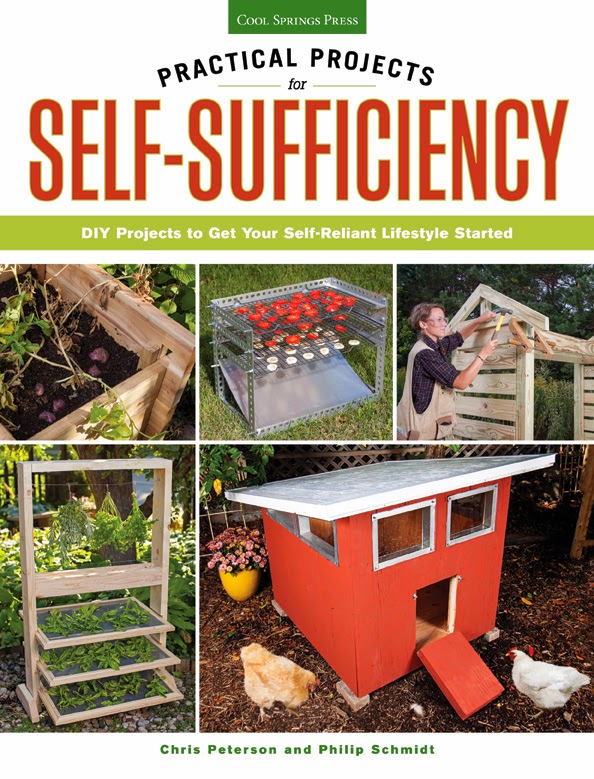
Review - Practical Projects for Self-Sufficiency by Chris Peterson and Philip Schmidt

I was invited to read Practical Projects for Self-Sufficiency by Chris Peterson and Philip Schmidt.

This book is a DIYers dream and includes something for everyone.

Interested in growing potatoes? You'll find excellent instructions for building a Potato-Growing Box.

Perhaps you want to wash clothes, without electricity, and without having to use a tiresome wash board. The Manual Laundry Washer is easy to build, easy to use, and will save money and the environment.

There are projects for raising chickens, growing critter-proof strawberries, and even one which repurposes a clothesline support to serve as a trellis (a brilliant idea).

Each project begins with a photo of the finished item and a few paragraphs about why it's a worthwhile endeavor. Materials and tools are listed and, if required, a lumber cutting list. Next are the step-by-step instructions. Each step includes a numbered photo along with written instructions.

Most of the projects include additional tips and information. For example, in the section about building a Teepee Trellis I learned about plant varieties which benefit from growing vertically ... some of them might surprise you. The instructions for building a Frame Loom include common weaving terms and a bit about using the loom.

Cool Springs Press has graciously given me permission to share an excerpt of the book with you. It's a great way to use the abundant variety of apples in the fall. Click the following link to read this tutorial:

CIDER PRESS


My Thoughts


Practical Projects for Self-Sufficiency offers a variety of projects which are appropriate for everyone. Whether you live in a small space or have a lot of property, you'll find something which fits your needs.

The book measures approximately 8-1/2" x 11" ... the size of a standard piece of printing paper. I mention the size because if you've ever tried to reference a small instruction booklet, then you know that they are hard to use while working. The large pages of this book make it easy to follow along at a glance.

The instructions are complete, including everything you'll need to know to successfully finish the project.

I highly recommend this book ... it encourages readers to lead a more sustainable lifestyle and offers great ideas which are practical for today's world.

If you'd like a copy of this book, please click HERE for purchasing information.


I received a copy of "Practical Projects for Self-Sufficiency" in order to write this review. I received no other compensation. All opinions expressed are mine and mine alone and reflect my honest opinion of the material reviewed.

Image and excerpt courtesy of Cool Springs Press


Tuesday, June 3, 2014

Guest Post - Why buy an electric bicycle? Go green and electrify your own bike!


Have you ever consider a DIY ebike? I'd like to introduce you to Micah Toll, author and ebike builder. He's going to talk to us, today, about this exciting, Eco-friendly mode of transportation. Take it away, Micah ...


Why buy an electric bicycle? Go green and electrify your own bike!
Electric bicycles have become a popular alternative to cars and public transportation in cities and suburbs across the country. Ebikes can travel at city speeds for dozens of miles on just pennies of electricity, give you the freedom of choosing between the road, bike lane or sidewalk to beat traffic jams and can save you lots of money by never needing to pay for insurance, parking, public transportation or gasoline, not to mention helping you live a more eco-friendly lifestyle!

Buying a commercially available retail electric bicycle is a great way to get going quickly and enjoy the immediate gratification of traveling by ebike, but converting your own bicycle into an ebike comes with many additional advantages over buying a retail ebike. Some of the best reasons to go the do-it-yourself route include saving money, increased customization opportunities and better quality parts, not to mention the pride of commuting on your own sweat and labor.

Why buy an electric bicycle? Go green and electrify your own bike!
How can building a DIY electric bicycle save you money over a retail ebike? When you buy retail, you aren’t just paying for the ebike, you’re actually covering all of the research, development, design, fabrication, assembly, marketing, shipping, storage, markup and overhead that goes into that getting that retail ebike out of the store and into your home.

When you decide to convert your own standard bicycle into an electric bicycle, you cut out all of that extra stuff and just pay for the ebike parts themselves. That’s why you can actually get the same parts from, for example, a $2,000 electric bicycle for a quarter of the price. Ebike conversion kits and individual ebike parts are available all over the internet. You used to only be able to buy them from Chinese suppliers, but now there are many American ebike kit companies in market.

Why buy an electric bicycle? Go green and electrify your own bike!
By choosing exactly the parts you want and not paying for extra accessories or specs of a retail ebike that you don’t need, you can save even more money. A complete conversion kit is usually the best way to go if you want convenience and a good deal, but sometimes you can actually find a better price by shopping around and buying parts from different suppliers.

Don’t worry if you aren’t a handyman/woman; ebike kits are really easy to install on nearly any bicycle. They’re specifically designed for absolute beginners so that pretty much anyone can convert a bicycle into an electric bike. You usually only need a couple of wrenches and a screwdriver.

Why buy an electric bicycle? Go green and electrify your own bike!

What I love about DIY ebikes is that when you get the chance to choose your own parts, you have total control over the performance of your ebike. There are so many different ebike kits out there that it is possible to find something for everyone, with speeds from as low as 12 mph (20 km/hr) or as fast as 35 mph (56 km/hr). The kit you choose will largely depend on your own desires. Are you looking for just an around-the-town-grocery-getter or more of a hot rod that can beat cars at traffic lights? Both options are entirely possible with different ebike conversion kits available all over the internet. Planning out your build with the right parts for you and then choosing the best vendors is something I cover extensively with many chapters in my book.

Why buy an electric bicycle? Go green and electrify your own bike!

Another great reason to build your own ebike is that you can start with a much better quality bicycle than standard retail ebikes. A dirty secret of the retail ebike industry is that many ebike manufacturers skimp on the quality of the actual bicycle, including the frame and components like brakes and shifters, so that they can try to bring the final price down enough to draw in consumers. By converting a bicycle yourself, you’re already saving a bunch of money, so why not put some of that back into a better quality bike? There’s a good chance you’ve already got a great bike just gathering dust in your garage or basement, so why not convert your bike into an ebike? Or you can get a bike you really like from your local bike shop and start the conversion on your new bike. This way you’re using a bike you already know and love, instead of settling for whatever bike the ebike manufacturer chose based on their bottom line.

Why buy an electric bicycle? Go green and electrify your own bike!
The last and perhaps best reason for converting your own bicycle to electric drive is simply the sense of accomplishment you’ll feel. It’s a great feeling every day when I commute on my ebike, knowing that I’m both doing a good thing for the environment by foregoing a car (I haven’t owned one in 6 years since I built my first ebike) and I’m also commuting on something I built with my own two hands.


Why buy an electric bicycle? Go green and electrify your own bike!

Converting an ebike is fairly easy to do, but some extra help will definitely make things easier. I’ve written a book to help first-time ebike builders through every step of the process, from the planning stages through installation of ebike parts all the way up to routine maintenance to keep an ebike in tip-top shape. You can check out my ebook at www.UltimateEbikeEbook.com and use the coupon code on the special offers page, or for the next few weeks you can get a copy of my book for a deep discount through my Kickstarter campaign.


All images courtesy of Micah Toll


Friday, November 15, 2013

Making Your Own Powdered Vegetable Bouillon

Have you ever considered making your own bouillon powder (aka dehydrated bouillon)? It's not only easy to do, but it's a healthy alternative to commercial versions which often include things like hydrogenated oils, Monosodium Glutamate, Salt, Palm Oil, and preservatives with unpronounceable names. It's also economical and a great way to use up extra veggies in your bin.

Here's my easy guide to making your own powdered vegetable bouillon:

Gather a variety of vegetables.


Make your own powdered vegetable bouillon.

Choose an assortment of vegetables. The goal is to create a nice balance of flavors, similar to making a good broth. I typically use tomatoes, onions, garlic, mushrooms, carrots, peppers (both bell and hot), and fresh herbs (parsley, basil, and oregano are my favorites). Any vegetable will work; however, use caution with strong-flavored items like cabbage or Brussel sprouts ... they can overwhelm your mix. Similarly, be careful if you're adding beets ... their vibrant color, while beautiful, may not be appropriate in all recipes ... a little goes a long ways. If you like your bouillon to have a slight thickening affect, add in a potato and/or peas. As a general rule, use the vegetables and flavors that you like.

Wash and slice


Make your own powdered vegetable bouillon

Wash the vegetables thoroughly, peel if necessary, and slice thinly. A Mandoline works great for uniform, thin slices. One can also use a food processor or a knife. The thinner the slices, the faster the pieces will dehydrate. Depending on how you'll dehydrate the vegetables, shape may matter. For example, the shelves in my dehydrator have openings to allow the air to circulate. Smaller items, like garlic, will fall through the openings. To alleviate the problem, one can often slice a vegetable into strips rather than rounds. When this isn't possible, line the shelf with a parchment paper.

Dehydrate


Make your own powdered vegetable bouillon.

Choose a method (the oven, a dehydrator, or the sun). For a good discussion on various techniques, read How To Dehydrate Food. I use a dehydrator. While it does use electricity, it supplies consistent heat and dries food quickly. I have also used the solar method ... it works, uses no electricity, but is less heat consistent ... food is much more likely to mold if there isn't constant heat.

When you've chosen your method, lay the vegetables out in a single layer and begin drying. Continue dehydrating until vegetables are completely dry. They should be a bit crispy to ensure that there is no moisture left in them. Moisture will make your finished product lumpy and increase the possibility of mold.

Grind


Make your own powdered vegetable bouillon

Grind the dehydrated vegetables into a powder. One can use a food processor, mortar & pestle, or (my favorite) a coffee grinder. At this point you can add in a bit of salt and pepper, if you wish.

Note: I recommend not adding salt or pepper to your bouillon mix. Doing so limits the amount you can use in your recipes. Instead, add the bouillon to your recipe and then add salt/pepper to taste. In this way, you'll have much more control of your meal's sodium content.

Storage


Make your own powdered vegetable bouillon

Store the finished product in an airtight container, preferably glass. Similar to spices, a cool dark location is best for maintaining the quality of your bouillon.

Uses


Make your own powdered vegetable bouillon.

Use your bouillon powder, mixed with water, as a soup base. Add it to stews, sauces, and gravies for additional flavor. Try a spoonful in your mashed potatoes or sprinkle it on a green salad. You are only limited by your imagination.

Homemade bouillon powder is easy to make, healthy, economical and delicious. I hope you'll give it a try!


Images courtesy of Michelle Meiklejohn, stockimages, John Kasawa, patpitchaya, artur84, and rakratchada torsap / FreeDigitalPhotos.net