Showing posts with label sustainability. Show all posts

Monday, April 20, 2015

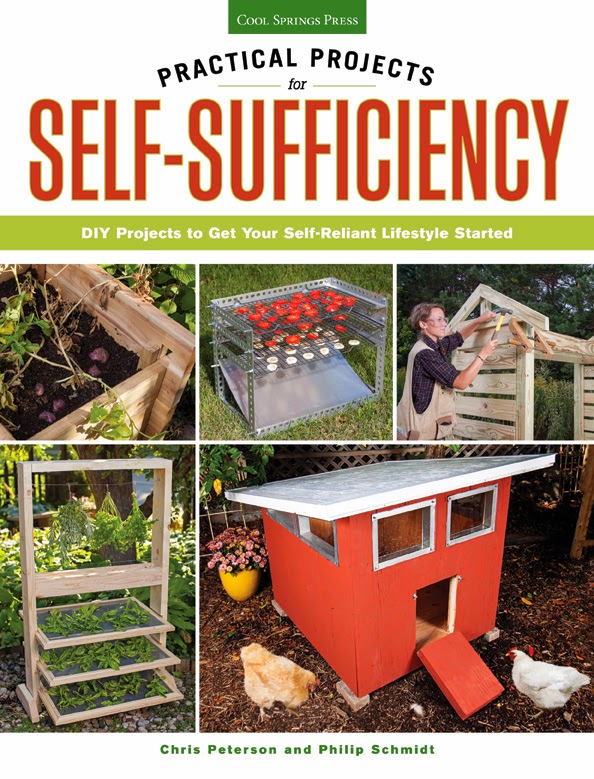
Review - Practical Projects for Self-Sufficiency by Chris Peterson and Philip Schmidt

Have you ever noticed how completing a do-it-yourself (DIY) project is so much more rewarding than buying something already made?

There is, of course, a real sense of pride; moreover, it gives us the opportunity to choose earth-friendly materials and build an item which will last. It also feels liberating to know that we can sustain our lives without depending on the "big box stores".

Since buying our property last year, we've taken on many DIY projects. With some of them, like the blue bird nesting boxes, we needed information so that we'd build something suitable for the preferences of these beautiful birds.

We turned to the Internet for instructions and while we found several sites offering how-to tutorials, they often left out key information, like where to hang the box so that the birds would be protected from predators.

The other drawback to online information is that it's not always easy to carry a computer to the work area for easy reference.
Review - Practical Projects for Self-Sufficiency by Chris Peterson and Philip Schmidt

I was invited to read Practical Projects for Self-Sufficiency by Chris Peterson and Philip Schmidt.

This book is a DIYers dream and includes something for everyone.

Interested in growing potatoes? You'll find excellent instructions for building a Potato-Growing Box.

Perhaps you want to wash clothes, without electricity, and without having to use a tiresome wash board. The Manual Laundry Washer is easy to build, easy to use, and will save money and the environment.

There are projects for raising chickens, growing critter-proof strawberries, and even one which repurposes a clothesline support to serve as a trellis (a brilliant idea).

Each project begins with a photo of the finished item and a few paragraphs about why it's a worthwhile endeavor. Materials and tools are listed and, if required, a lumber cutting list. Next are the step-by-step instructions. Each step includes a numbered photo along with written instructions.

Most of the projects include additional tips and information. For example, in the section about building a Teepee Trellis I learned about plant varieties which benefit from growing vertically ... some of them might surprise you. The instructions for building a Frame Loom include common weaving terms and a bit about using the loom.

Cool Springs Press has graciously given me permission to share an excerpt of the book with you. It's a great way to use the abundant variety of apples in the fall. Click the following link to read this tutorial:

CIDER PRESS


My Thoughts


Practical Projects for Self-Sufficiency offers a variety of projects which are appropriate for everyone. Whether you live in a small space or have a lot of property, you'll find something which fits your needs.

The book measures approximately 8-1/2" x 11" ... the size of a standard piece of printing paper. I mention the size because if you've ever tried to reference a small instruction booklet, then you know that they are hard to use while working. The large pages of this book make it easy to follow along at a glance.

The instructions are complete, including everything you'll need to know to successfully finish the project.

I highly recommend this book ... it encourages readers to lead a more sustainable lifestyle and offers great ideas which are practical for today's world.

If you'd like a copy of this book, please click HERE for purchasing information.


I received a copy of "Practical Projects for Self-Sufficiency" in order to write this review. I received no other compensation. All opinions expressed are mine and mine alone and reflect my honest opinion of the material reviewed.

Image and excerpt courtesy of Cool Springs Press


Tuesday, November 5, 2013

Review - Uncommon Goods

Are you prepared for holiday gift giving? While I don't like to hurry the season, the fact is that Christmas is less than two months away. Finding earth-friendly products which are made locally (or at the very least in the same country), and are sold by a responsible company, takes time and effort. Luckily, Uncommon Goods make it a bit easier for us by offering a wide range of unique gifts.

Before I tell you about the product I tested, let me tell you a bit about the company. Most of the products they carry are made in the United States. Approximately one third are made using recycled and/or upcycled materials. About half of their products are handmade.

It is, however, their commitment to the earth and their dedication to humanity which I find most impressive.

As with any corporation, they are interested in profit. But unlike other corporations, Uncommon Goods also consider society and the environment in their decision making process. For example, employees are paid a living wage and all full-time workers are offered health insurance (most part-time workers receive it as well). Each business practice is tempered by the goal to create harmony with the environment. They do nothing which causes harm to either people or animals and refuse, therefore, to sell products containing leather, feathers or fur. In addition to meeting the comprehensive requirements of a B Corporation, they have created "Better to Give", a program which donates $1 from every sale to the purchaser's non-profit of choice.

A company's ethics are definitely important but so are their products. As I browsed the Uncommon Goods website, I found interesting gifts ... items which I've never seen anywhere else. For example, from their recycled products, I was sent a set of Man Coasters:

Man Coasters from Uncommon Goods

These sturdy coasters are made from salvaged granite slab counter-tops and recycled rubber. Each one is distinct in pattern and color. Handmade by artists Arra David and Anne Johnson in New Hampshire, the coasters are guaranteed for life.

How do they perform? BRILLIANTLY! I keep a glass of water or iced tea next to my computer as I work throughout the day. Typical coasters stick to the bottom of the glass or fail to deal with condensation (don't you hate it when you lift a glass and it's drips on everything). Man Coasters, measuring 4" squared x 1.25" thick, are designed not to stick to the glass and they magically wick away condensation. They truly are the best coasters I've ever used.

How do they look? When I saw them on the website, I was worried that they would be a little too "manly". But I have to say that I love how they look on my coffee table. The granite is beautiful and the rubber case enhances the intricacies of the stone. The coaster size is also a benefit ... no one will misunderstand its use or have to look very hard to find one.

I recommend Uncommon Goods. You'll find bed and bath products, jewelry and accessories, and gifts for the person who has everything ... like this unusual item. You'll also shop with the knowledge that you are supporting an ethical company, one which respects the earth and all who call it home.

So, relax ... Christmas may be less than two months away but this company has you covered.


I received a set of Man Coasters in order to write this review. I received no other compensation. All opinions expressed are mine and mine alone and reflect my honest opinion of the material reviewed.


Tuesday, October 22, 2013

Guest Post - What Can the Middle East Teach Us About Sustainability?

When one thinks about urban development in the Middle East, sustainability may not be the first idea that springs to mind. But recent reports show that, as a matter of fact, the Middle East is actually leading the way when it comes to implementing sustainable practices.

Disparate Attitudes


This news has come as a surprise to many, particularly in light of the disparate attitudes towards promoting sustainability which are held by Middle East and Western governments. The British government, for example, introduced a tax which made it exponentially more expensive to purchase landfill space in the UK. In addition, there are many more resources available, from companies such as Mark Group, for homeowners who want to shore up the sustainability of their homes. By contrast, there have historically been significantly fewer financial incentives provided in the Middle East for the development of green buildings.

International Findings


Nonetheless, the findings of a major international study which was recently commissioned by the UN Global Compact has shown that, when it comes to sustainability, the Middle East is actually ahead of the global game. In particular, Qatar is shaping up to be an international player on the sustainability stage, with strong investment in circular economy and incentive driven green developments at the forefront of urban policy.

Increased Trade Benefits Sustainable Development


It certainly helps that certain Middle Eastern regions have been benefitting from increased trade, which follows a slump caused by the global financial recession. Increased spending has meant that there is more consumer interest in shopping locations which had previously been overlooked. The famous Mall of the Emirates, for example, is one of the only shopping centres in the world to be in receipt of a prestigious LEED gold award.

Recognising Demand


Perhaps at the heart of the Middle East’s sustainable overhaul is a government and developer-driven recognition of the need to understand the requirements of people at both local and regional levels. To uphold this ethos, commercial standards were first implemented in government buildings before being applied elsewhere. In addition, water and electricity costs are heavily subsidised throughout many Middle Eastern markets, and government sponsored initiatives to reduce carbon emissions are being introduced across the UAE.

So, what can we learn from the Middle East about sustainability? Their greatest successes seem to stem from paying close attention to the needs and requirements of people, consumers and businesses at a local level. Communication, as ever, seems to be at the heart of success.


Friday, October 11, 2013

Review - Sustainable Disposable Products by Eco-Products

I don't like single-use, disposable products and avoid them. That said, I also know that there are times when a reusable product isn't realistic.

For example, hosting a party, picnic or dinner for a large organization or business would mean buying reusable plates, utensils, glasses, etc. That would be expensive and then there's the problem of washing and storing the items.

Reusable plates and glasses, which are usually breakable, are not safe for pool parties. Sure, one can buy plastic products but plastic has problems of it's own.

Let's say you're hosting a family wedding, anniversary celebration or retirement party. Again, it might not be practical to supply reusable items.

While I'd love to live in a world devoid of disposables, the fact is that our society regularly uses them. Unless you stay at home and never venture out into the public sphere, you've probably been given a disposable item ... straws, carry-out boxes, napkins, etc.

Yes we avoid them ... yes we encourage others to avoid them ... we even contact stores and restaurants asking them to discontinue their use. But maybe we're looking at this in the wrong way. Maybe we need to investigate a disposable product made from earth-friendly, safe and sustainable materials ... a product which, after serving its purpose, can be composted.

The folks at Eco-Products are doing exactly that. They offer cups, cutlery, containers, plates, etc., made from renewable sugarcane (the GreenStripe product line) and products made from post-consumer recycled content (the BlueStripe line). They also offer other services like waste diversion consulting where they help clients make their business or event more sustainable.


The GreenStripe products are made from renewable plant materials, not petroleum. They are compostable in commercial facilities ... it's not recommended that they be composted in backyard bins because personal compost piles cannot generate enough heat to efficiently breakdown these products.

Products in the BlueStripe line can be recycled in most communities, with the exception of the hot cups which aren't recyclable.


At this point you might be thinking that they are better than traditional disposable products but still ... not perfect. You're right and Eco-Products understands that. They are committed to continually searching for new ways to make both their business practices and products more planet-friendly. Visit their Impact Assessment Page to read about how their products impact the environment. If you're interested in how their business (headquartered in Boulder, Colorado) impacts the environment, you'll find that informatiion HERE.

So now that you know who they are and what they sell, let's talk about product quality.

I received a box of samples which included just about everything they make.

The plates and bowls are sturdy and come in sizes to meet every need. I loaded them up with raw vegetables, juicy fruits and even used one as a cutting board. These are not your average paper plates ... they held up well.

The cups and containers also performed well ... no leaks, comfortable to hold and they come in various sizes.

The cutlery is strong ... I was able to cut vegetables and fruits with the knives.

Cutlery from Eco-Products

While I still encourage you to avoid single-use, disposable dinnerware and food containers, I believe that Eco-Products have a place in our world. If you are entertaining on a large scale, own a company or a restaurant, or require unbreakable, safe items, then these products might be for you. They are an earth-friendly option when "reusable" isn't appropriate.

Browse around the Eco-Products Store and let me know what you think.


I received samples from Eco-Products in order to write this review. I received no other compensation. All opinions expressed are mine and mine alone and reflect my honest opinion of the material reviewed.


Tuesday, September 24, 2013

Guest Post - Why Bamboo Flooring is the Eco Friendly Alternative to Wood

The trouble with wood flooring

Wood flooring can be a gorgeous addition to any home, as wood is often both more beautiful than carpeting and also more durable. A good wood floor can improve the property value of your home as well, and as wood floors are relatively easy to install, the cost of making the switch is relatively low.

However, as with any major change to your home, wood floors present unique challenges to the homeowner. One of your biggest concerns when installing a wood floor may be the environmental impact of the change, since the creation of a beautiful hardwood floor requires a good deal of logging and not all tree harvesting is done in an environmentally friendly way.

While there are many suppliers that source their wood from second-growth forests that are grown especially for their wood, it can be easy to stumble across less scrupulous suppliers that are harvesting their wood directly from shrinking rainforests or vulnerable wilderness habitats. Even with the various certifications that exist to show that wood has been sustainably harvested, it can become nearly impossible to be certain that your new floor was brought to you by a responsible and ethical company.

An Eco-friendly alternative

Bamboo flooring avoids all of these issues. Because bamboo is a type of grass, not a tree, it grows incredibly fast--many times faster than any other wood source. A single bamboo plant can grow incredibly quickly, sometimes as much as 3 feet in a single day. That means that a piece of wood that would take years for a rainforest to produce can emerge from a bamboo stand in one growing season.

Because bamboo grows so quickly, it's much easier for bamboo forests to meet the ever-growing demands of the wood industry. Bamboo flooring takes much less resource to produce than traditional hardwoods, and bamboo harvesting has a much smaller environmental impact because of this. Wood taken from a bamboo stand can simply be replenished within a year or two, as opposed to ordinary forests, which when cut down often never recover. In their home ecologies, bamboo species thrive in warm temperatures and take advantage of heavy, intense rainy seasons. This tropical plant is used to putting out huge volumes of new growth as quickly as possible, which makes it an ideal substitute for hardwoods.

A different variety for every need

There are dozens of different species of bamboo, and each grows in its own unique way. Clumping bamboo tends to grow new stalks in a small area, while running bamboo sends out "runners" that create new plants all along the root system in a chain. Both species are fast growing, but running bamboo is the fastest-spreading type, and uncontained can swiftly take over large areas. In fact, when introduced to foreign environments, some bamboo species are considered invasive and can quickly overwhelm local ecosystems.

Thanks to the huge variety of bamboo species currently living, your new bamboo flooring will have a unique and beautiful texture completely unlike any other hardwood floor. The long grains and fibres of the bamboo plant give this type of wood a very intricate, organic pattern that is especially beautiful in modern homes, and bamboo floors can be found in an astonishing array of colours and shades.

Durability first

Since the fibres of the plant are springy and flexible but just as woody as any tree, bamboo makes an ideal flooring material. Typical bamboo floors are smooth with a satin-like texture, and take stains, sealers, and top coats extremely well.

But how durable is bamboo flooring? The answer depends on the additives included in the material. Stalks of bamboo aren't simply cut down and sawed into planks the way trees are. Bamboo fibres, before they become solid wood floors, are broken down into strands and then woven and reintegrated with adhesives to bind them more closely together.

Traditional construction bamboo, made by laying the bamboo stocks crosswise against the planking of the floor, has a Janka rating hardness of between 900 and 1300, a good mid-level rating. This type of bamboo may be susceptible to small scratches if you move your furniture regularly, but can be protected with rugs and sealers.

Strand-woven bamboo, however, is woven much more tightly among the strands, and uses more adhesive to create a higher hardness rating of between 2000 and 3200, near the peak end of the Janka scale. These floors are as tough as any hardwood and will certainly stand the test of time. Shop carefully for your specific needs.

Which bamboo is best for you?

Whether you're looking for a cherry red or a lighter blonde colour, there's certainly a bamboo available for you. Be sure to carefully research the flooring that will best suit your needs, and enjoy your beautiful new floor!


Mark Hutchison founded bamboo flooring company Bamboozle, based in Perth, Western Australia. You can connect with Mark on Google Plus, too.
.


Wednesday, July 31, 2013

Change The World Wednesday (#CTWW) - Sign A Petition

Welcome to Change The World Wednesday (#CTWW)!

Wondering how to live greener? You've come to the right place. Each week we challenge ourselves to try a new task ... or "amp up" something we're already doing. We raise our awareness, learn from each other and develop Eco-friendly skills which will improve our lives and protect our planet. Doing so together gives us power ... the power to Change The World!

If this is your first visit, please click HERE for information and a complete list of all the challenges we've taken on so far.

This post contains great information and I encourage you to read through it at your leisure ... however, if you are short on time, you might find the following quick links helpful:


During periods of hot weather, using counter-top appliances is preferable to heating up a kitchen with the oven or stove. Farmer's markets are overflowing with produce, making raw foods a good option as well. So meeting last week's challenge wasn't all that difficult. In my house, we prefer a crockpot, toaster oven and electric fry pan over either the stove or oven. We also use a pressure cooker which cuts down cooking time significantly. And raw salads are one of our favorite summertime meals. As the week progressed, I thought about how we could use these techniques in the winter, when local, fresh produce isn't plentiful ... and when hearty, warming meals are preferred. When the temperatures drop and the heat from an oven feels good, that's when our Eco-commitment comes into play ... it's something to think about!

The Honor Society are those people who help us spread the "green" word by writing an article about our challenges and/or leaving pertinent comments.

This challenge was timely for Laura who not only accepted it but offered additional ideas: "It's so cool that you wrote this as I just purchased a toaster oven and set it up 2 days ago. Plus I can suggest two other ways to cook food that some may not know about. One is a dutch oven. Good ones are hard to find, but they cook faster than other types of appliances and with less energy and bonus they keep all of the moisture in the food including meat if you are a meat eater (sorry I still am). The secret is the tight fitting lid. There is also the "smoker" which is like a grill except it comes with a water pan to keep the food moist and also with a temperature gauge so you know you have the temperature in the correct range if you are cooking a big chunk of pork,beef or a whole chicken. Just a few ideas for those who eat meat, but vegetables can be cooked with these appliances as well." Thanks, Laura ... a dutch oven and a smoker are both terrific suggestions!

When I think of Brazil I think warm temperatures, bathing suits and sun ... lots of sun. It was a total "shocker" to read Argentum Vulgaris' post, Change the World Wednesday – 24th Jul, and find the reason behind this statement: "This weeks CTWW is just not going to happen!" Socks with flip-flops??? Oh no!!

Did you know that you can use your rice cooker to prepare other foods? In Change the World Wednesday, Cooking, Lois talks about her purchases from a local farmer's market and which vegetable she won't eat raw. Here's a hint ... it's not corn, which she enjoys uncooked.

CelloMom stopped by and shared this, "The height of summer is when produce is at its best - you can (I've done this) eat corn right off the stalk without cooking it. Add some tomatoes of the heirloom type, and you have a meal! Right now things are best eaten without too much interference from the cook, anyway. This avoids heating up the kitchen, reduces the need for air conditioning, plus you don't have as many dishes to clean. I love this season. Had a gazpacho the other day, and am thinking of trying one of those pasta sauces which are raw." By the way, CelloMom recently wrote a terrific post about a small town in Switzerland going car-free. It's really an interesting post and makes me wonder if we could do it in our city.

Alicia suggests another method of cooking to reduce energy use: "We grill a lot and I got a dutch oven this past year and Laura is so right it does cook faster. We are trying to incorporate more raw food recipes into our weekly meal planning. Also we are looking into buying a crock pot. It has been years since we have had one and I am excited to use one again."

Lisa's post, Easy Energy Saving Ideas, includes a fascinating table which compares energy use and cost of various cooking methods. Any guesses on which method uses the least amount of energy? Does low energy equal low cost? Visit Lisa to find out!

If you tried an alternate cooking method which resulted in a "vile" meal, would you try it again? Not only did Mrs. Green try again, she tried a third time after creating a second dish which could only be described as ... well ... I'll let her tell you. Check out Why I ate lunch at 10am to save the world to find out what didn't work and whether or not she came up with an energy-saving way to fix her favorite lunch. Here's a hint ... oh yes she did!

Our Twitter friends joined the conversation and shared the following:

From @givetreegifts
- I invested in a cookbook that highlights recipes that feature & fully utilize your counter top appliances. It's awesome.
- 1 of my fave counter top appliances is a George Foreman roaster. I can make a roast & even brownies for dessert without using the oven
- Another fave countertop appliance is the slow cooker. Awesome, homemade meals including stew, soup, roasts...mmmm

From @laalicia
- Youth Orchestraâ??s Instruments All Made From Recycled Landfill Trash ow.ly/ndiZo

From @rulesofgreen
- So many good recipies to try this week! #rawfood #CTWW here is one: Hovkonditorn: Raw Blueberry Lemon Cheesecake hovkonditorn.blogspot.com/2013/07/raw-blâ?¦

The #CTWW Gang are those folks who tweet our challenges using the hashtag #CTWW. If you're a Twitter member, I recommend following them ... they share great things. Let's meet them:

@a_kiasi @allnaturalkatie @anitaadamsnc
@beckymcneer @biggreenpen @bstoneblog
@cleansediva @clothaddicts @conservationm
@counselorholley @crazykids6 @dusdifissette
@eco_novice @ecoexpert1 @ecopro_co
@ecothrifty @ecwrites @evelynmccpeters
@familyfocusblog @friendsoftrees @ginavalley
@givetreegifts @gr8fulgirl11 @groovygreenlivi
@hismerecry @ithoughtiknewma @jadekerrion
@jnaquins @jnjgogreen @juliarbarrett
@kayelleallen @laalicia @lady_bren
@ladybugpicnics @ladyjcmuses @leslieveg
@lifelovemusic1 @lorcadamon @mamapoolecooks
@marjoriemcatee @mom2tle @nolafusion
@ppatch_blog @rantravewrite @rckweddings
@realityarts @rulesofgreen @ruralmoms
@skipbang @soulfullab @soundless2
@tammycurry @timsimms @treesgroup
@trinathomas48 @tristinandtyler @wencdj
@whopaysthepiper @whywelovegreen @women4earth
@zenfarmz

Thanks, everyone! If you wrote an article, I Stumbled, Tweeted, Facebooked and posted it on Google +.

Please help spread the "green" word by using the share features located below this post.

This Week's Challenge:

This week we're going to become activists. Here's your challenge ...

Have you heard about the Tar Sands Oil Pipeline? It not only threatens wildlife and natural habitat, it threatens drinking water. While it directly affects Canada and the United States, it sets a dangerous precedent worldwide ... that the use of fossil fuel is acceptable. Let's raise our voices and let the world know that we not only want to stop the Tar Sands Oil Pipeline but we want sustainable, environmentally-safe energy. Please sign this Petition (appropriate worldwide).

OR ...

Choose any of the petitions found HERE (or choose a cause specific to your area) and take action.

OR ...

Contact your public officials via letter, email or phone regarding your environmental concerns.

Let's tell the world that we care! Will you join me?

Until next time ...

WE'RE CHANGING THE WORLD ... ONE CHALLENGE AT A TIME!


Saturday, April 20, 2013

Guest Post - The Breakdown on Vinyl
by Nathan Lucas

You have probably heard of the Great Pacific Garbage Patch, which is the result of non-biodegradable plastic waste. Since it’s already larger than the size of Texas (a state that takes at least twelve hours to drive across) wouldn’t it make sense to reduce the use of non-biodegradable plastic? Decreasing use of anything from disposable silverware and soda bottles to sheets of vinyl used for advertising and industrial grade PVC could help slow down the growth of waste accumulated in the environment.

Fortunately, there are already companies taking action to reduce the amount of non-biodegradable waste they produce. For instance, a sign company called Signazon has found a way to reduce the use of vinyl by supplying their customers with a sustainable alternative named EZ-Stick. EZ-Stick was designed so that it can be recycled and degrade naturally over time. Though it takes time to decompose, it will not remain in our landfills or the ocean forever. Adding to that, EZ-Stick is free from PVC and harmful toxins like phthalates. For those who aren’t familiar with the effects of phthalates, they have been identified as endocrine disruptors and have been tied to reproductive and neurological damage.


Source: Courtney Spencer - http://psychiclemonade.com/design.html

Fortunately, the quality of the product does not have to suffer when searching for greener solutions. Not only is EZ-Stick safe for the environment, it actually turns out to be more convenient than vinyl since it allows for friendlier installation. Firstly, reusable EZ-Stick fabric decals will not wrinkle or tear so they are easy to maintain, and they can last up to 3 years without curling or losing its hold. It is so user friendly that you can remove and reposition your design hundreds of times without losing holding power. Lastly, it can be easily installed on ANY flat surface – as long as they are non-porous. This green alternative is a win-win solution for sustainable substitutes.

Please spread the word about our green decal material so we can slowly wean off of buying non-biodegradable vinyl- especially when EZ-Stick better suits their needs because vinyl isn’t reusable, repositionable, or biodegradable. EZ-Stick is truly a miracle product, and Signazon is proud that they can offer it as alternatives for products like wall decals, removable decals, and decorative wall signs. It would be shame for people to miss out on this.


Friday, January 15, 2010

Environmental Beauty

I have this belief that living an environmentally-friendly life means not just protecting the earth but also protecting every living thing on the earth. While I personally try never to kill anything .. plant, animal or otherwise ... that's not really what I'm talking about. I'm talking about how and what humans take from nature ... that desire to be excessive ... the idea that if one thing is good, then a billion things is better ... with no thought to sustainability.

If one studies nature, it is apparent that there is balance ... and if left alone, nature seems to check itself. When food is available, a species thrives and typically becomes food for another species, higher on the food chain. Or, if predators don't control populations, the species will grow until the food source can no longer sustain it ... and starvation will check population growth.

At one time in human history, people were part of that balance. We took what we needed to survive but nothing more. Then, man got greedy and decided that more was better. And that had an impact on every species on the earth.

Even at that point, man could almost be forgiven his gluttony ... after all, he was taking plants and animals which would be sold for food and clothing. Necessities! But then, man got preoccupied with status and wealth and looking good. Exotic animal populations were devastated because man (and woman) wanted unusual boots, furs, beautiful feathers in their hats, and trophies on their wall. And "balance" became a thing of the past.

And that's the part I have a problem with ... taking so much from nature that species become extinct. Let's face it ... we don't exactly know what will happen to us as various species forever disappear. We don't know what it will do to the quality of our life ... or to our very existence. I'm guessing that it could be devastating.

While I wandered around the Internet last month, I came upon a disturbing trend ... ornamental feathers. I started to see posts and ads about jewelry made with feathers ... about boas and headbands and dusters and shawls ... all made with beautiful, exotic feathers. They were, indeed, beautiful! But I began to wonder how those feathers were obtained. I'd like to say that feathers were collected as birds molted. But, that's just not the case. They are obtained in ways that I won't mention here ... it's too ugly.

In the US, laws state that feathers can only be obtained from domesticated birds. So, the majority of them are a by-product of the poultry industry. But are we simply using every part of the bird, as advertisers would tell us ... or are birds being raised specifically for their feathers? We've talked about the environmental cost of raising animals ... it's extremely high. Additionally, if the demand for ornamental feathers increases, does anyone believe that it won't be met ... and met with more and more exotic species? That opens us up for the reduction and/or elimination of bird species because of their beauty. It happened in the 1800s ... it could happen today.

We've talked about meatless meals ... because they are environmentally friendly. Let's expand that to include meatless, or animal free products ... because they are also environmentally friendly.

As always ... I would love to hear from you!